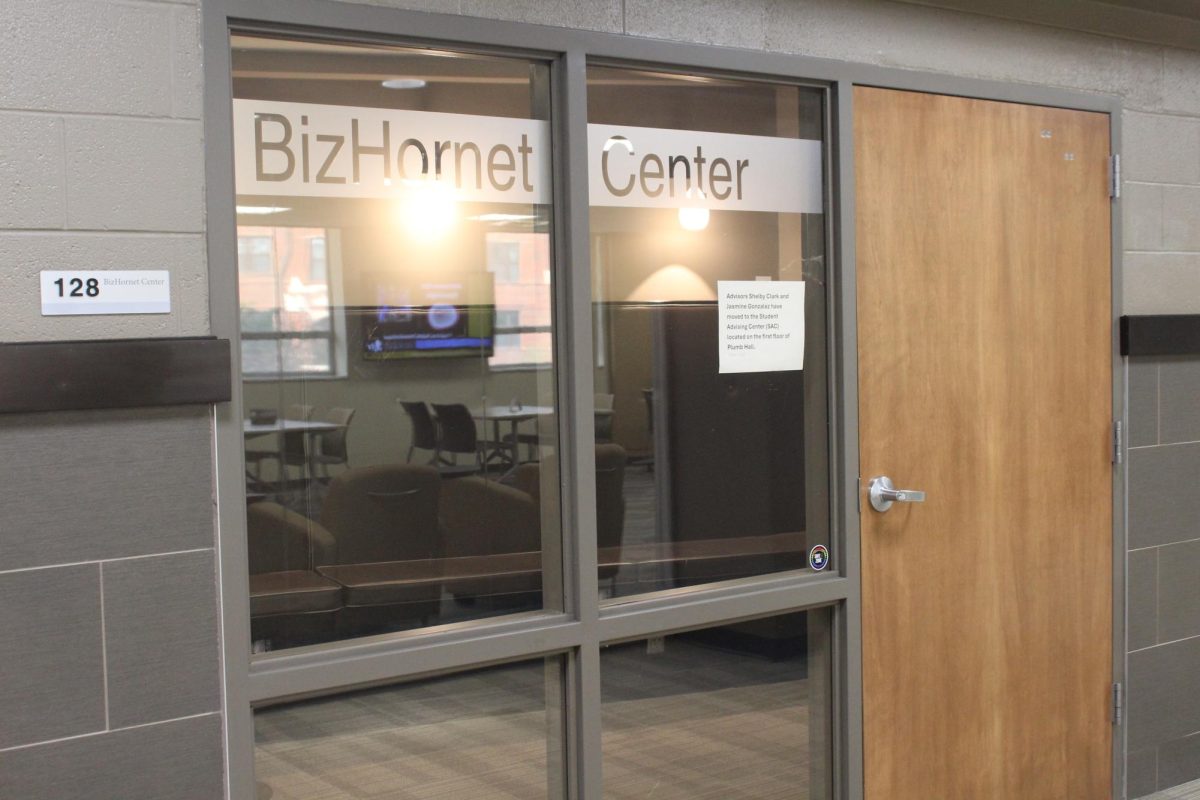
The School of Business and Technology’s BizHornet Center has served business students at Emporia State for over a decade. Now, its future remains unclear.
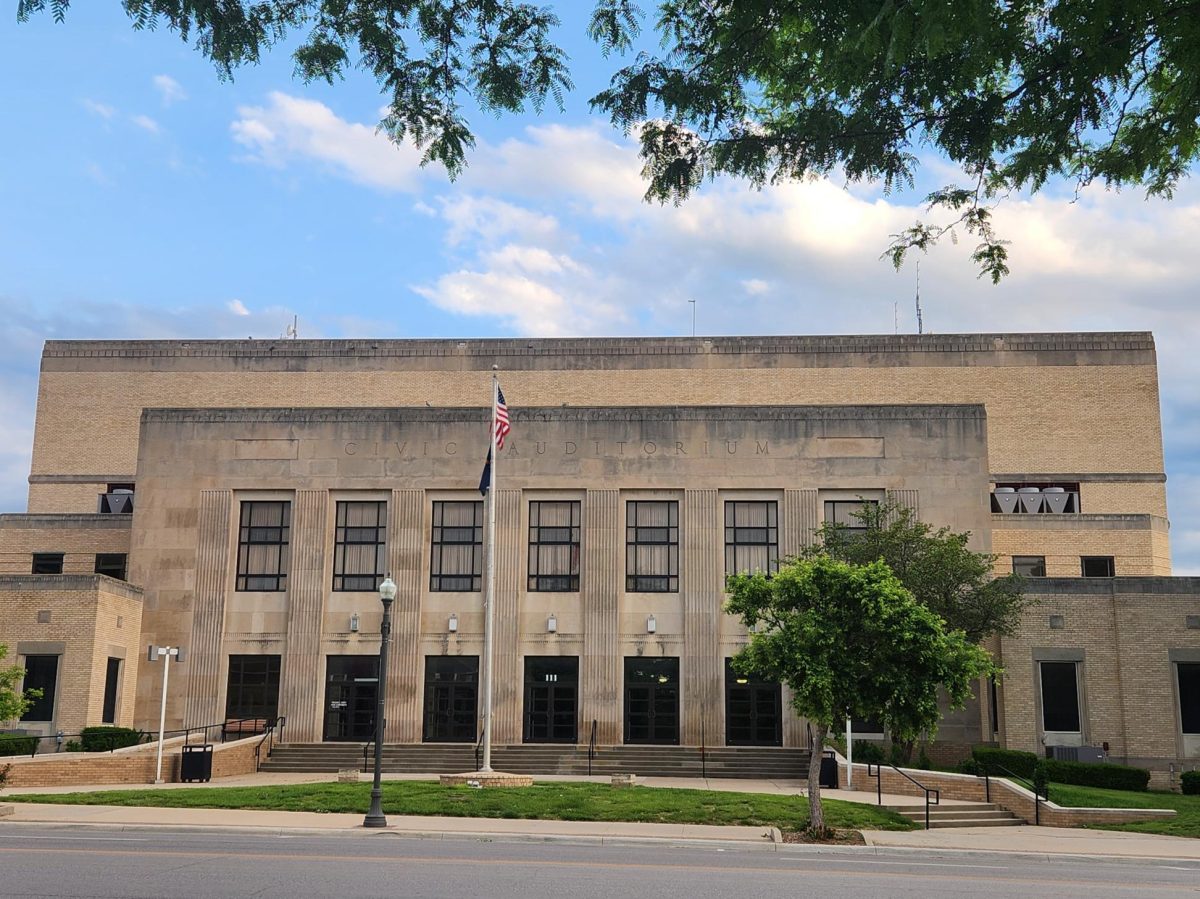
Following the university’s shift to complete centralized advising this semester, most offices in the BizHornet Center are now empty. Located in Cremer Hall, the center was created as a student hub that provided academic advising as well as services unique to SBT– scholarship resources, internship placement, and student employment, to name a few.
Earlier this year, ESU’s Division of Student Success centralized academic advising completely. The advisors for SBT and the Teachers College’s were relocated from their academic buildings into the Student Advising Center (SAC) in Plumb Hall. BizHornet Center director Shelby Clark and engagement and retention specialist Jasmine Gonzalez moved out of their offices, leaving the BizHornet Center nearly vacant
The BizHornet Center previously held an advising-specific position until the end of the 2024-25 academic year. This position was not filled by the university, so Clark filled in as an advisor.
Move to centralized advising
Sara Schwerdtfeger, dean of the Teachers College, said that the advisors for SBT and the Teachers College were overseen by the deans of their respective schools, who were not trained in academic advising.
“So then this is now the transition to move everyone to the same spot for centralized advising,” said Schwerdtfeger. “It’s really to help support all the advisors, to help ensure that they’re cross-trained in different areas…”
Taylor Kriley, executive vice president for enrollment management & student success, said that the university also had concerns that the advising load for SBT and Teachers College advisors was too large.
“So we wanted to continue to streamline and create efficiency where we’re seeing consistent concerns from students,” said Kriley.
BizHornet functions dropped
Following the sudden move to the SAC, Clark has had to give up most of her directorial duties in favor of focusing on academic advising. She said that it was hard enough already being short an advisor, but leaving the BizHornet Center made these things unfeasible. Most of the center’s services and events had to be dropped.
“We just don’t have the power to do it anymore,” Clark said.
She is unsure whether or not the BizHornet Center will be able to host their events and offer all of its services to students in the future.
“So there’s still a lot of unknowns, but at this point … I don’t know if conversations have been had yet, but I really don’t know, kind of, what the thought process is there,” she said.
“(Moving to the SAC) makes it really difficult for (Clark and Gonzalez) to be able to perform the functions of what their real job descriptions say,” said Shawn Keough, dean of the School of Business and Technology.
Junior business administration major Cooper Schroer said that he and other SBT students received no prior notification or explanation about the move of their advisors.
He appreciated the convenience of being able to walk into the BizHornet Center and speak to his RSO’s advisor at any time. Now, he said that it is difficult to get across campus to speak with the BizHornet staff.
“There’s no reason to go in (the BizHornet Center) now,” said Schroer. “If we want to get a hold of any advisors for our clubs, we’ve got to go across town (to Plumb). Now it’s all virtual, but it’s nice to … sit down and actually talk to them face to face.”
Funding concerns
The salaries of BizHornet Center employees are paid for by SBT student fees, which is why SBT faculty and administration are concerned about their inability to complete their original jobs. Over a decade ago, students in the School of Business voted “overwhelmingly” to support the BizHornet Center by paying a fee, according to Clark.
Currently, students pay $13 per credit hour they take from SBT.
According to Angela Wolgram, executive vice president of finance, most of the other advisors in the SAC are paid with state general funds and tuition revenue, not student fees.
“We were specifically told that we would continue to pay the salaries from the BizHornet Center,” said Keough.
Keough explained that the academic advising position, which has not been filled, was created to “specifically allow someone like Shelby (Clark), who’s the director and is not an advisor at all, to do her job.” He is concerned that the funds meant to support the BizHornet Center are not being used appropriately now that Clark is in the SAC full-time.
“Are those funds being used for what their actual position roles are? At this point, I don’t think there could be any argument that they’re being utilized the way they’re being paid,” Keough expressed.
Schroer also does not believe that the fees that he pays to attend SBT are being utilized correctly. He said that he does not feel like he’s getting his “money’s worth” out of the student fees.
While Keough admitted that SBT does have control over those fees, he does not think that pushing back further would yield good results.
“I think that I could absolutely walk into any office and tell them, ‘I am not going to pay this anymore,’ and I absolutely believe that if I did that today, on Monday, you would be talking to a new interim dean,” he said.
AACSB accreditations concerns
The School of Business and Technology is one of 6% of schools worldwide that are accredited by the Association to Advance Collegiate Schools of Business (AACSB). As the SBT nears its year of review with AACSB, SBT faculty and administration, the loss of many BizHornet functions will be detrimental to its reaccreditation.
Every six years, AACSB-accredited schools go through a Continuous Improvement Review (CIR) to maintain their accreditation status. In the most recent CIR document for ESU, the BizHornet Center was cited over 20 times as an effective resource for students and a large factor of student engagement and retention.
“A big part of AACSB accreditation is student outcomes,” explained Keough. “That’s one of their standards, so to speak, that they want to see … The career services side, the professional development side, the development at the individual side…making sure that they’re getting good experiences, internships. All of those things are things that AACSB look at.”
Keough, the CIR and the FY 2022 tuition proposal all reported that the BizHornet Center contributed to SBT’s 100 percent job placement rate and significant increase in retention.
“My fear is they’re going to come in…and they’re going to say ‘BizHornet Center was doing all these things, and now they’re not.’” said Keough. “And that puts us at risk for either them saying we’re not comfortable reaccrediting you or they … put us under a second review… it looks bad reputationally for the university, it looks bad for the School of Business, and it looks really bad for recruiting.”
Future uncertain, potential solutions
Kriley said that funds from student fees will continue to support advising. She hopes that SBT will utilize the relatively new learning communities model to take over some of the services the BizHornet Center provides.
“We hope that students are continuing to build the relationships with faculty in their classes, engaging in those applied learning opportunities outside the classroom,” said Kriley.
Keough agrees that SBT needs to “align with the university as a whole” so that ESU can be as successful as possible. But, he sees the compromise going in a different direction.
He said that the BizHornet Center could go through restructuring to take the advising component out of the description. However, this would require that the SBT advisors are not paid with SBT student fees so that they can go towards other initiatives through the BizHornet Center.
“That separation needs to be made very clear,” Keough stated. “The university needs to make clear this is how we’re going to do this, and those student funds that are specific to the BizHornet Center need to be reallocated to do the things just that are within the confines of the BizHornet Center.”