Emporia State’s Leadership Team announced Thursday that the university has made changes to its restroom signage to comply with Kansas Senate Bill 244, a new state law that took effect Feb. 26.
“The law mandates immediate compliance to male/female designation for restrooms with multiple stalls,” leadership wrote in an email. “Signage has been updated to bring us into compliance with the law. Restrooms for single use will remain unchanged.”
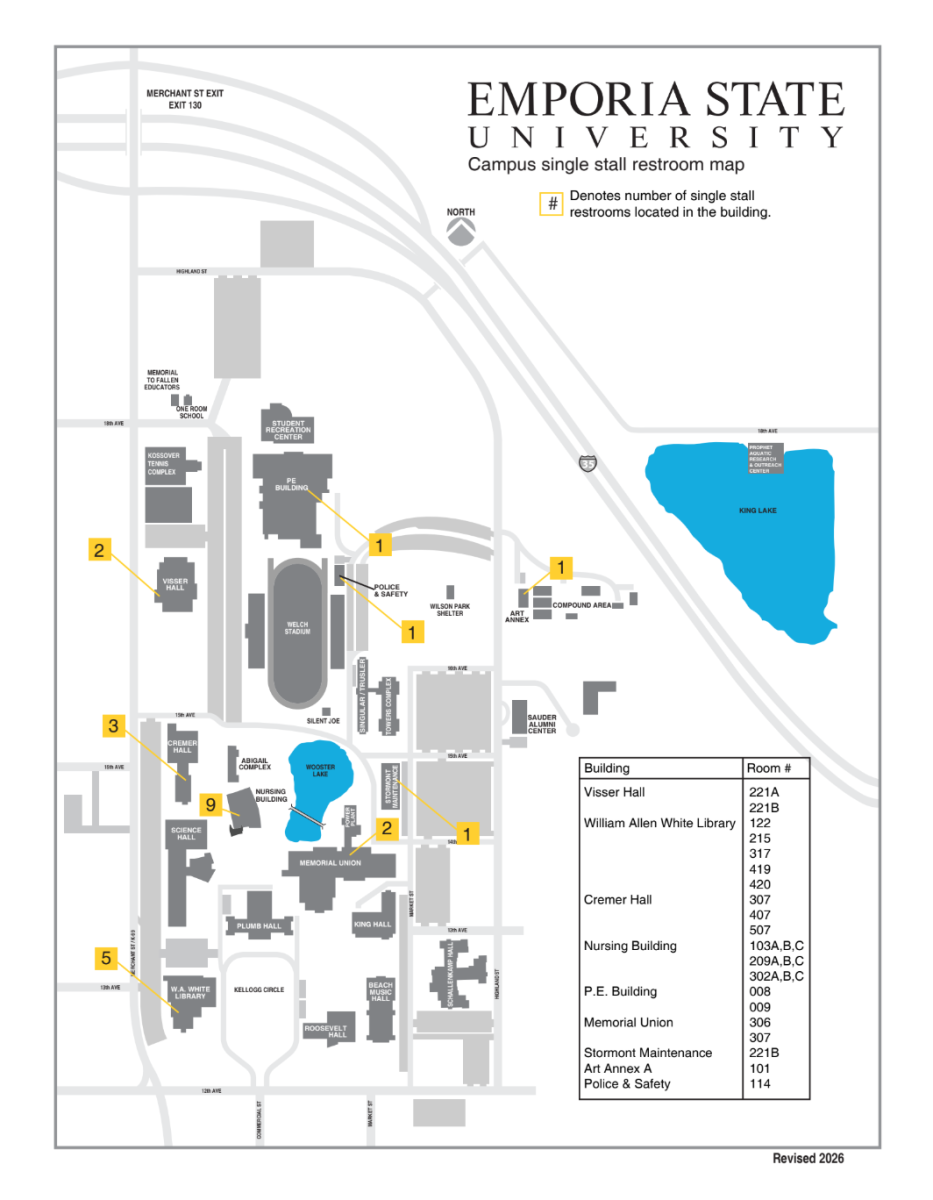
ESU has 25 single-use restrooms campus wide, including nine in the Nursing and Student Wellness Center and 5 in William Allen White Library. The Memorial Union has only two single-use restrooms, located on the third floor. Plumb Hall, the university’s administrative building, has zero; a stalled unisex restroom in the east wing of the ground floor has been converted to a men’s restroom.
Leadership said they will communicate any additional guidance by the Kansas Board of Regents on compliance with the law.
“We know that this is personal for some in our campus community,” they said. “Emporia State continues to be committed to being a welcoming campus community for all Hornets while ensuring compliance with the law.”
What does SB244 do?
SB244, which became law on an override of Gov. Laura Kelly’s veto by the Kansas Legislature, requires that multiple-occupancy private spaces in government-owned buildings, such as restrooms and locker rooms, are designated for use by sex. It prohibits individuals from using multiple-occupancy private spaces other than those that reflect their birth sex — with few exceptions — and instills civil and criminal penalties for individuals and entities that fail to comply.
Public entities who violate SB244 face a $25,000 fine on the first offense and fine of $125,000 for each subsequent violation. Individuals are liable for a $1,000 fine if they violate the law after an initial written warning and could face a class B misdemeanor charge for violating the law a third time or more. In Kansas, a class B misdemeanor carries up to six months of jail time.
The bill allows individuals to bring civil action against someone of the opposite sex if they are “aggrieved by the invasion of (their) personal privacy” or “otherwise harmed” by that person’s use of a sex-assigned space that does not align with their sex at birth.
It is unclear how public entities will ensure individual compliance with the law.
Other conditions of SB244 rendered driver’s licenses invalid for transgender Kansans who changed their gender markers.
After the veto override, many transgender Kansans received letters from the Kansas Department of Revenue notifying them of their invalid driver’s license. The letters instructed recipients to surrender their license to the Division of Vehicles to receive an updated credential that reflects their birth sex.
Through the law, legislators retroactively adjusted the state’s definition of gender to mean sex at birth and required drivers licenses and birth certificates to reflect one’s biological sex. The bill directed the Office of Vital Statistics to amend any birth certificates that have had the sex marker changed.
The Bulletin continues to monitor the impacts of SB244 on ESU’s campus. This is a developing story.