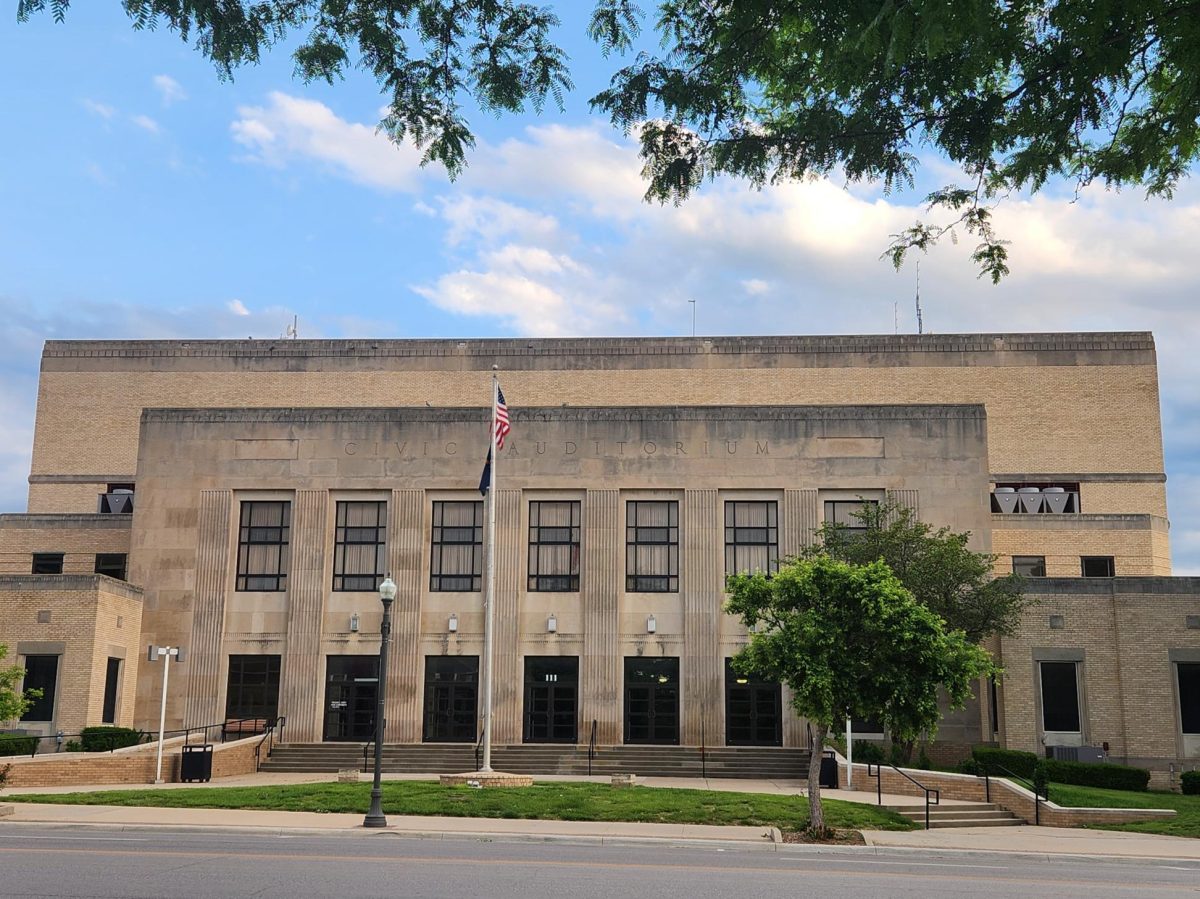
Feb. 15 marks the 93rd birthday of Corky the Hornet, Emporia State’s beloved mascot who debuted in 1933 as the mascot of Kansas State Teachers College.
Although archives of The Bulletin indicate that Corky was originally created in the fall of 1933, the University celebrates his birthday along with its own.
Corky’s evolution lines the Memorial Union wall opposite the Hornets Nest, from his 1933 inaugural debut to his current condition, but little is publicly displayed about his history: how he came to be, where he got his name or the controversy Corky’s presence sparked in the 1970s.
The Bulletin dove through ESU’s library archive to uncover how the hornet became the symbol of pride he is today.
Corky’s story begins around 1922 when the mascot of Kansas State Normal School, which would have a multiple rebrands before becoming ESU, was not officially a hornet.
According to a 1978 edition of The Bulletin, the original mascot for KSN came about when a coach suggested to an Emporia Gazette reporter that the KSN football team be nicknamed the “yellowjackets” because of their yellow and black striped sweaters. “Yellowjackets” was often shortened to “hornets” to save column space, and that the two words were used interchangeably, the article said. A realistic, six-legged insect was used for the likeness of the yellowjacket and hornet.
In November 1933, after the school’s first name change to Kansas State Teachers College, The Bulletin launched a competition with a prize of $5 for “the most satisfactory design for a collegiate sticker to paste on cars or baggage.” The design required that the name of the school appear, and it was merely a suggestion that the design incorporate a hornet or yellowjacket.
Enter Richard Waller and Paul Edwards.
Waller won the contest with a realistic rendition of a hornet, according to a 1986 issue of The Bulletin and 2009 Spotlight magazine issue. However, another student, Edwards, decided that a proper mascot needed to have human characteristics. So, Edwards revised his original entry and brought it back to The Bulletin.
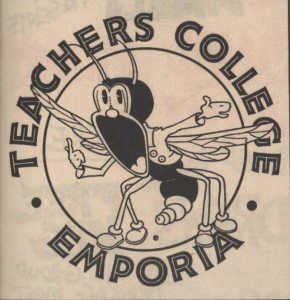
The sources disagree on whether Waller withdrew his design after seeing Edwards’ or if a second vote was held between the two designs, but Edwards’s four-legged, large-mouthed caricaturized hornet design was eventually chosen over Waller’s. Two years later, Edwards patented the design with the help of William Allen White, and his hornet was only authorized for use by KSTC.
Edwards’ hornet remained unnamed until 1935 when The Bulletin launched a series of cartoons called “Corky Comments,” which were drawn by Edwards. The cartoons depicted the hornet in various comical situations, making remarks on incidents that occurred on campus.
The first release of “Corky Comments” shows Corky standing on a box of Sunkist oranges as he appears to be yelling to an unknown audience. The caption reads:
“If political powwows were pep assemblies, and campaign enthusiasm school spirit, K.S T.C. would mark up conference victories for the next decade.”
In the Spotlight, Edwards said that the hornet was “always popping off” like a cork, and thus was officially named Corky.
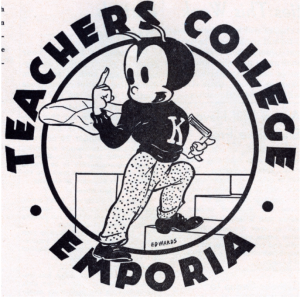
Corky continued to appear in print in his original form until Edwards created a new sticker design for KSTC between 1936 and 1938. The hornet’s second pair of legs were removed and his mouth appeared much smaller; in a way, he seemed to resemble Disney’s signature mouse, Mickey. As coincidence would have it, after serving in World War II, Edwards went on to take an animation position at Walt Disney Animation Studios in the late 1940s.
In 1941, Corky found himself a girlfriend which often remains a little-known fact. The girlfriend was unnamed and appeared infrequently in The Bulletin and ESU’s yearbook, The Sunflower for a time. She hasn’t been seen in print for decades since then.
The two-legged Corky stood as the representative of KSTC from the 1940s to the 1970s and he was portrayed participating in numerous student activities like football and marching band. During that time period, he also was given slight modifications.
In the 1960s, Corky was made to look happier with wide eyes and a big smile. By the early 70s, Edwards had slightly modified Corky again, this time to appear more menacing, with a frown instead of a smile and adding his signature unibrow.
Corky also fell into two bouts of controversy during that decade, both of which aligned with KSTC’s two name changes.
KSTC first changed its name to Emporia Kansas State College in 1974. In September of that year, The Bulletin published an article titled “Corky Needs Help.” The article told a story of how Corky walked into The Bulletin’s office, complaining of “abuse.” An excerpt says:
“Some say that Corky should have a smile instead of a determined frown; some say that Corky should have a girlfriend; and some are even downright sick and tired of Corky.”
The Bulletin published a survey with 14 different iterations of Corky to see which version students would like to see around campus. A month later, it was revealed that out of 49 students who voted, 42 voted to keep Corky the same.
“Please leave Mr. Edwards’ ‘Corky’ alone or start over with a completely new concept of how a hornet looks,” one survey respondent said.
The issue was left alone for three years, until the Corky controversy resurfaced when EKSC changed its name to Emporia State University.
A December 1977 issue of The Bulletin revealed that a meeting between students and administrators discussed whether or not Corky should be modernized. The result of that meeting was to ask Edwards to draw up possible revisions of the hornet.
In a February 1978 issue, Bulletin writers asked students and faculty their opinions on whether or not Corky should be modernized. Some believed Corky was “fine the way he is.” Others thought that he was due for an update.
One student is quoted as saying “he looks kind of dumb.” An assistant registrar felt that he needed to be “more fierce” so as to not “(detract) from our reputation.”
The article detailed that some people didn’t like Corky’s human characteristics—that it made him “less of a hornet.” One student even referred to Corky as “that (a homophobic slur) little bee,” a phrase that stuck for the remainder of the 1978 controversy.
A week later, an opinion published in The Bulletin expressed that students should be able to vote on whether to keep Corky the same, ask Edwards to update him, redesign the hornet entirely or scrap the hornet mascot altogether and choose something new.
The end of February saw a Bulletin edition that was filled with Corky controversy.
A reader opinion said that changing the mascot could damage ESU’s already unstable image, presumably brought on by multiple name changes. Another reader submitted a satirical opinion that Corky should be scrapped in favor of “the ever present head louse.”
The edition featured three of Paul Edwards’ possible revisions, a student’s muscular hornet drawing and a drawing of “Corky the nit.”
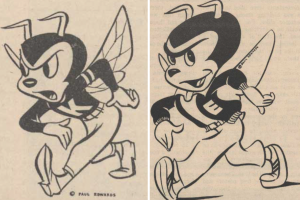
ESU eventually opted to use a revised version of Corky, a move announced by The Bulletin in April 1978 following an informal meeting of ESU students, faculty and administrators. The revised Corky drawn by Edwards featured a slight facelift and an outfit change.
In the nearly five decades since then, the only thing that has changed about Corky in print is his outfit, which now features the Power E on his shirt. The mascot suit often worn at university activities and sporting events, however, has accrued multiple changes with time, from the “fiberglass head” used in the 1970s to the most recent full-body suit change revealed during ESU’s 2025 Homecoming football game.
Although Corky has changed quite a bit in the past 93 years, his identity as Emporia State’s mascot has persisted—even as the university’s name hasn’t. Happy birthday, Corky!