
Editor’s note 2/18/26: This story has been updated with additional and corrected information.
Emporia State Associated Student Government voted unanimously Thursday on a set of bills that will merge and create Line Item Organizations and set line item fee rates for fiscal year 2027.
Line Item Organizations, or LIOs, are organizations that obtain funding each semester through student fees charged to the Campus Activity Fee. Each year, LIOs may request changes to their fee rate, which are approved or denied by ASG’s Fiscal Affairs Committee.
“The overall goal was first to kind of look at areas where students are using and support those areas more and then look at where we have opportunities to continue what organizations are doing really good, if they need a little more funds to do what they need to do (and) be able to support some ideas and some experiments without having to go too crazy,” said Fiscal Affairs Chair Joel Franz in a post-approval interview with The Bulletin.
ASG approved fee rate increases for the Campus Recycling Initiative and The Bulletin line items. Students expressed interest in campus composting measures, and the increase to the Campus Recycling Initiative LIO will “not risk too much money” while allowing composting measures to begin, said Franz.
New rates for the recycling initiative will be $3.38 for full-time students, an increase of 63 cents, and 15 cents for part-time students.
The Bulletin did not request a student fee increase for fiscal year 2027, but did request one last academic year for fiscal year 2026. The Bulletin’s increase request was approved, but the funds were instead provided by the ESU Foundation to keep student fees flat for the 2025-26 academic year. The Fiscal Affairs Committee raised The Bulletin’s rate for fiscal year 2027 in case funding from the ESU Foundation is discontinued next year.
The Bulletin’s new rate will be $11.25 for full-time students and $1.38 for part time students. While the part-time rate remains unchanged, the full-time rate has increased by $1.00.
“(With The Bulletin) we really kind of saw some opportunity to fund it more, especially if kind of one-time funding from the ESU Foundation, if that ceases, we still have an increase in funds to kind of fall back on,” said Franz
Funding decreases were handed to The Sunflower, ESU’s yearbook, and the Performing Arts Board of the School of Visual and Performing Arts.
Franz said the decision to pursue a nearly 20 percent funding cut to the yearbook on both the part-time and full-time fees stemmed from low student utilization and low staff retention. Currently, The Sunflower employs one student and a faculty adviser, according to Franz. At the Thursday Senate meeting, Franz said he counted a substantial amount of yearbooks from past years still sitting in the Memorial Union and other locations on campus.
The Sunflower did not respond to a request for comment about the funding decrease and inquiry about their employee structure by the time of publication.
As for the Performing Arts Board, the board’s funding saw a reduction in funds just over 14 percent on both the part-time and full-time levels.
In a Feb. 18 statement to The Bulletin, ASG clarified the operational structure of the Performing Arts Board and the reasons for the allocation decrease.
“While the (Visual Arts Board) and (Performing Arts Board) have begun merging their boards operationally, Fiscal Affairs wanted to ensure their finances would not be consolidated in a way that could be absorbed by one or the (other) in the future,” ASG said in the statement. “As a result, the LIOs will remain financially separate, even though the board will function as one unified body. (Visual Arts Board) funding remained unchanged; the decrease applied only to (the Performing Arts Board) for several reasons.”
The main goal of allocations this year was to establish more return on investment for students; as such, Fiscal Affairs and ASG “sought feedback on whether students felt they were receiving a strong return on investment from LIOs and their intended purposes.” The Performing Arts Board was the largest LIO allocation, but only 7 percent of ESU students belong to the School of Visual and Performing Arts, said ASG. All students can participate on the board, but when compared to RSOs, the impact is “lower than overall RSO impact.”
As the Performing Arts Board is part of the School of Visual and Performing Arts, it will also reap the benefits of the new Student Arts and Spirit Programs Engagement Fee, which repurposes the Athletic Band Stipend. The Athletic Band Stipend line item previously helped fund student scholarships for ESU’s spirit programs, which are now paid for by the ESU Foundation.
The main purpose of the fee will be to fund uniforms, coaching staff, travel and other expenses for ESU spirit programs, including for the Marching Hornets, Hornet Cheer, Stingers Dance and the ESU Colorguard. The Performing Arts Board “will still have access to significant support” through the fee as it provides “discretionary funding managed at the Dean and Board’s departmental discretion.”
“Given the availability of strong reserves and the fact that over 30 percent of the LIO fee will still support the School of Visual and Performing Arts if slightly reduced, we determined this area would be least impacted by a reduction,” ASG said.
ASG President Azwad Zahraan clarified in an email to The Bulletin that if funds from the Student Arts and Spirit Programs Engagement Fee are put toward expenses for the Performing Arts Board or Visual Arts Board, their use must first be approved by the Fiscal Affairs team.
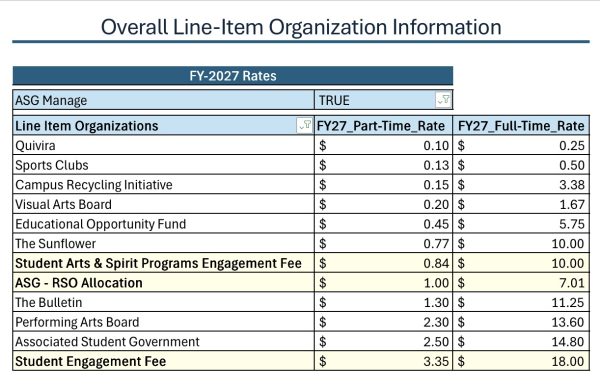
A spreadsheet shows updated line item fee rates for fiscal year 2027. New line item organizations are highlighted in yellow. Courtesy of Joel FranzAlongside the Student Arts and Spirit Programs Engagement Fee, ASG also approved the creation of two additional line items: the Student Engagement Fee and the ASG-RSO Allocation Fee.
The Student Engagement Fee combines three previously individual line items for the Student Life Office into one fee. The Union Activities Council will be the priority recipient of the funds, but the merger will “allow (the) Student Life Office to better work together with proper funding and less confusion to better fund student events.”
The Special Events Board and Community Hornets, which are no longer active but were combined for simplicity, make up the two other individual line items merged with the UAC line item under the new fee. The fee rate is the highest of all line item rates at $3.35 for part-time students and $18.00 for full-time students.
“The goal of that one is really to take the funds that were getting the money anyways, combine them and make it a little simpler … Instead of three separate funds, it’s one larger fund so it’ll allow local simplicity,” Franz said.
The most significant change to come from the new line item legislation is the creation of a line item specifically for Recognized Student Organizations, or RSOs. RSOs are currently funded through the ASG budget and receive money from the Senate’s reserve funds. RSOs make an allocation request and ASG approves, denies or modifies the amount.
Now, that process has proven to be unsustainable. Vice President Josh Manahan indicated Thursday that the current funding process has strained ASG’s budget and will only continue to do so. Franz referred to it as a “negative cycle.”
“We’ve had a lot of success (with RSO allocations) and right now the amount of funds requested far surpasses the amount of funds that we can give. We can’t even come close to covering what we get requested,” said Franz.
Starting in the fall, RSOs will be funded through the ASG-RSO Allocation line item. All money accrued through this fund will be put toward RSOs. The request process will stay the same, but will “allow (ASG) to give, hopefully down the road, more funds” according to Franz.
“To implement (the ASG-RSO Allocation line item) without raising overall fees, Fiscal Affairs identified LIO reductions that were logical, measured, and supported by clear reasoning,” ASG’s Feb. 18 statement said, referring to the allocation decreases to the Performing Arts Board and The Sunflower, which helped support the new funding model for RSOs.
Franz assured Senate members on Thursday that the changes approved by the Senate will not increase fees for students attending ESU for the 2026-27 academic year. The goal was to either decrease fees altogether or keep them flat, he told The Bulletin.
“Overall, the (Campus Activity) Fee will be no different. It’ll be the exact same fee for students … it’s net neutral, which was kind of the goal,” he said.