Emporia State Theatre will explore themes of poverty, morality and religion with its production of Major Barbara this weekend. Major Barbara was written by Academy Award and Nobel Prize winner George Bernard Shaw in 1905.
Dennis Turney, Jr., associate professor of theater and director of Major Barbara, described the play as a “discussion play” in three-acts based on “drama of ideas.” Turney explained that the playwright, Shaw, used this drama of ideas in Major Barbara to challenge the way society tackled poverty.
The plot follows an affluent woman named Barbara Undershaft who lives in London and works with the Salvation Army to help the poor. Her estranged father, Andrew Undershaft has made millions manufacturing and selling munitions, which Barbara is morally opposed to. When they reunite, Turney explained that each character is set on converting the other’s morals to their own.
“But it’s not really about the story so much as the idea of, ‘What is the best way that we can handle poverty?’” said Turney describing the underlying themes. “And the play has a lot of different sort of styles, but it’s primarily a comedy … Shaw thought that’s the way he would best be able to change the world, get people to think, but also chuckle at the same time.”
Despite the play’s 1905 premiere, Turney found that the play still holds relevance over 120 years later with its themes of poverty He also cited the play’s heavily political nature as a factor of relevance.
“Poverty might be the issue in this play, and I still think that that resonates,” said Turney, “But the things that they discuss about morality, religion, the purpose of government, the purpose of religious organizations, how they work together, is still something that goes on today … You could insert any issue you wanted in here, and Shaw’s point is, or what the point he wants to make is: what is really the best way to handle these things?”
Turney noted that he appreciates the civility of political discussions in Major Barbara. The characters enjoy debating the issues with each other rather than “devolv(ing) into emotions and anger.” He believes that Shaw’s message to audiences is that people with different political opinions “can come together to make society better if they choose to.”
Although Turney has his own opinions about Shaw’s purpose for Major Barbara, he wants audiences to come to their own conclusions. He hopes that Shaw will make them listen and think about their own views on morality and religion.
“What I really want to know is not ‘I want you to take this away (from the play).’ I want to ask the question, ‘What did you take away from it?’ … I find almost every time anything is said, it makes you think there’s lots of different points of view on the stage about issues we all care about,” he said.
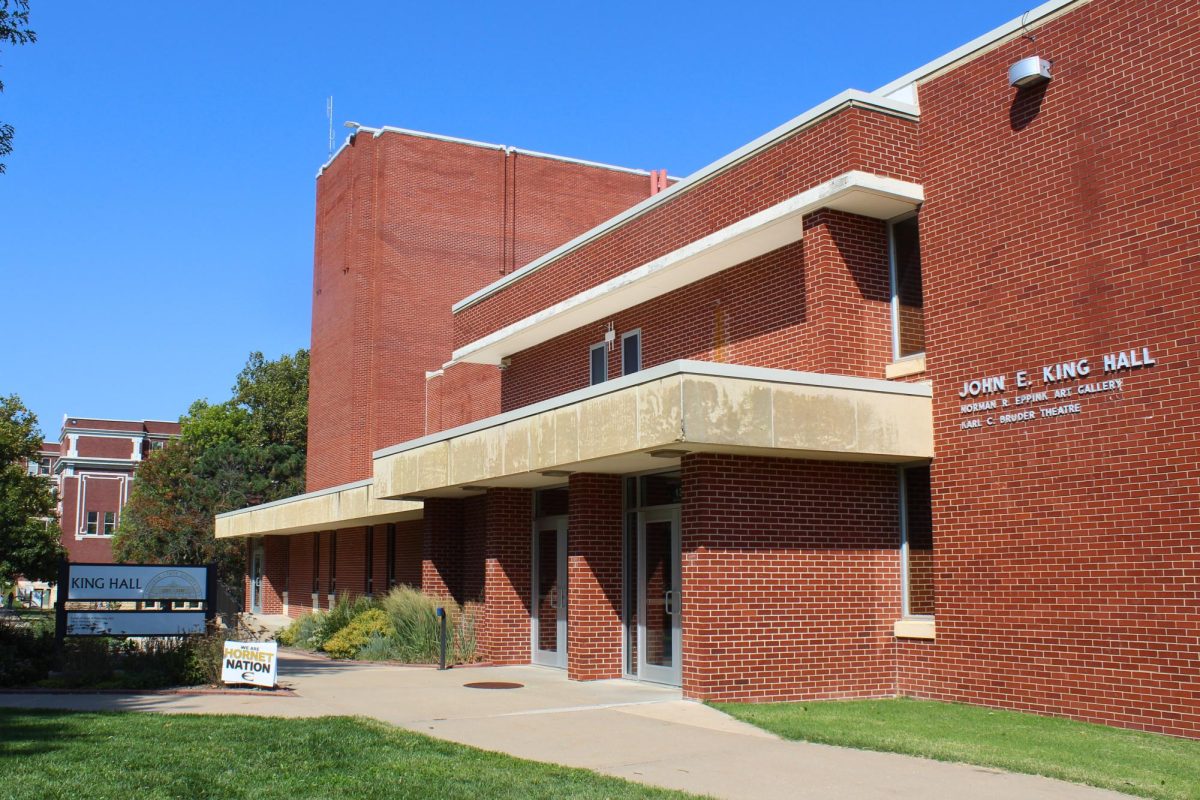
Major Barbara will open March 5 at 7:30 p.m. in King Hall’s Bruder Theatre with a two and half hour approximate runtime. The show will run through the weekend, with 7:30 p.m. performances on Friday and Saturday, and a 2:00 p.m. matinee on Sunday. Admission is $18 for general audiences, $13 for seniors, ESU staff and Theatre Guild Members, and free for students and children.
The cast includes Kaycee Schulte as Barbara Undershaft; Jim Harris as Andrew Undershaft; Matthew Womble as Adolphus Cusins; Nautianna GoForth as Lady Britomart Undershaft; Alex Knudsen as Stephen Undershaft; Elliot Johnston as Charles Lomax; Atticus Smith as Sarah Undershaft; Xavier MJ Huffman as Bill Walker; Ross Owen as Rummy Mitchens; Collin Newland as Snobby Price; Kaitlynn Tarrant as Mrs. Baines; Lucas Perez-Leahy as Peter Shirley; Grey Mink as Jenny Hill; and Jasper Enneking as Morrison/Bilton.