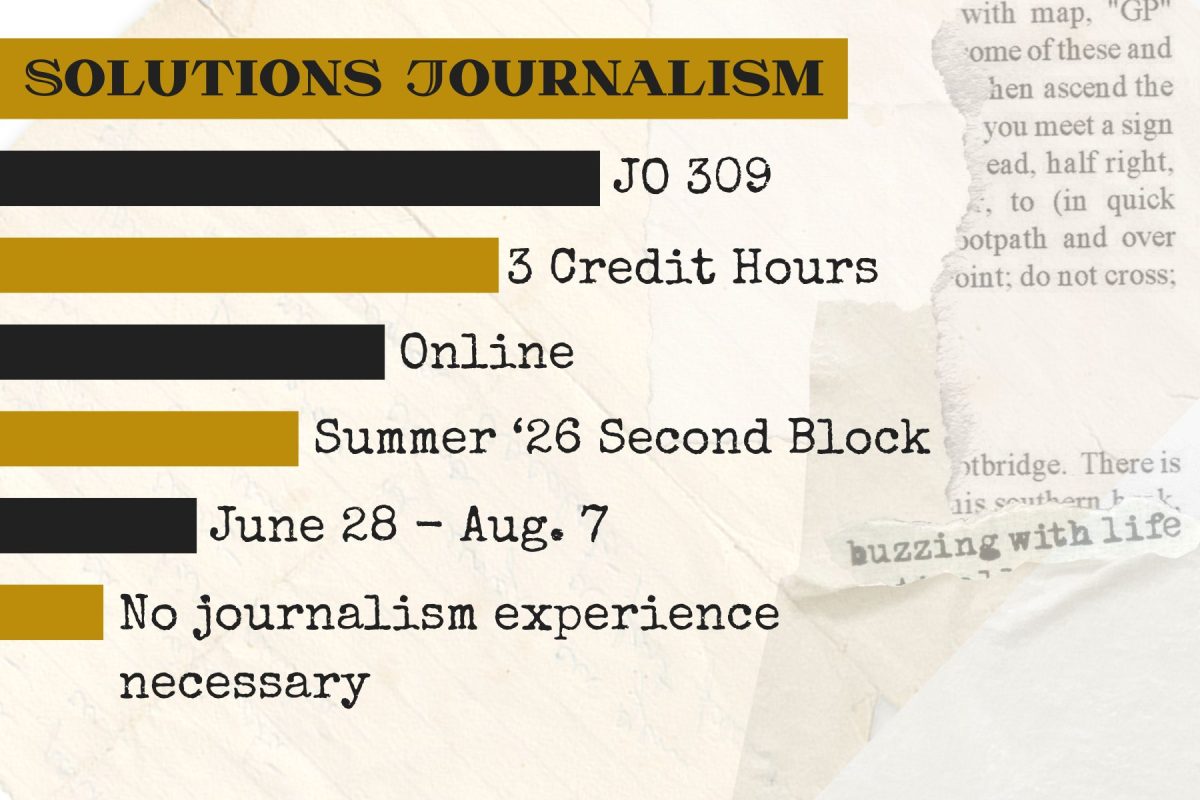
Students at Emporia State looking for summer courses will have a new writing course to add to their considerations. Taught by instructor Theresa Mix, the School of Humanities and Social Sciences will offer JO 309 Solutions Journalism as a three-credit-hour online course during the second block of summer courses from June 28 to Aug. 7.
The course is being offered to give students in the Languages, Literary Studies and Writing program and English Education program an alternative to taking creative writing courses they may need to fulfill their degree requirements, Mix explained. She said the summer course is like a “pilot” course to gauge student interest in similar journalism courses.
Journalism courses have not been offered at ESU since the teach out for the journalism minor program concluded at the end of the fall 2024 semester. ESU discontinued the journalism minor as part of the Workforce Management Framework implemented in the fall of 2022. The framework led to the firing of 33 faculty members, including tenured and tenure-track faculty, cut several academic programs and resulted in a complete academic restructuring. Max McCoy, who led the journalism program and served as the then faculty adviser of The Bulletin, was one of those fired as a result of the framework.
Mix describes solutions journalism as a “form of journalism that goes beyond breaking news.” Instead of focusing on the “who”, “what”, “when” and “where” of a news story, solutions journalism dives deeper into the “why” and “how,” she said. In particular, solutions journalism looks at social problems and attempts to uncover how communities address them.
“For instance, if there’s an issue, let’s say homelessness…and the breaking news is maybe they found a homeless person who had froze to death, that kind of thing. That’s the breaking news, right? Solutions journalism would say ‘there’s an issue with homelessness.’ So what do other communities do to try to resolve this issue so that homeless (people) do not freeze to death? So (journalists) might find a community that creates different shelters for them or provides housing, or, you know, meals, or whatever it might be,” explained Mix.
Throughout the course, students will gain experience with multiple types of journalism associated with solutions journalism, such as civic journalism, constructive journalism and explanatory journalism, Mix said. There is no prerequisite for the course and no journalism experience is needed to enroll.
Mix believes the Solutions Journalism course will benefit and interest students of any major, especially sociology students due to the course’s emphasis on social problems. She hopes that after students take the course, they will be “encouraged to look beyond the obvious” of breaking news.
“Even though… it is a writing course…we dig into social issues and explore, you know, what people have done to try to alleviate (a) problem,” she said. “ And I kind of think that’s what sociology (does)— they kind of dig into areas and communities and ideas that have affected us as a civilization and look for the details of ‘why this has happened, how does this happen?’ which is exactly what solution journalism tries to answer.”